AttenGW: Gravitational-Wave Detection Pipeline 2025
Resources: Paper (Old version) | AttenGW GitHub (Old version) | RADAR Paper (integration example)
Implementation: Python with PyTorch/PyTorch Lightning for HPC and multi-GPU training.
Low-latency gravitational-wave detection is challenging because true signals are rare and often buried in non-stationary detector noise, while follow-up facilities need reliable triggers within seconds. At the same time, several observatories operate under data-locality constraints, making it impractical to stream raw data to a central location for further analysis. AttenGW was developed as a deployable, end-to-end GW detection pipeline for real LIGO data: it includes a GWOSC-based data download and preprocessing workflow, injected-signal dataset construction, model training and inference, and low-latency trigger generation. It can also be exposed through interfaces that make it straightforward to plug into federated, multi-messenger workflows such as RADAR.
Model & Training:I developed AttenGW as a standalone, deployable pipeline covering preprocessing/data loading, injected-signal dataset construction, model training, and trigger generation on real interferometer data, with an emphasis on reliable low-latency triggers on non-stationary noise and practical deployment close to the data. An earlier version of this detector was integrated into RADAR as a federated GW component; in that setting, my module served as one component within the broader RADAR stack (with the federated infrastructure and radio-analysis layer led by collaborators).
The core model is a WaveNet-style Hierarchical Dilated Convolutional Network (HDCN) that processes Hanford (H) and Livingston (L) strain independently to capture long-range temporal structure in fixed-length windows. Its outputs are combined by an attention-based aggregator that performs cross-channel communication between detectors to produce a per-timestep GW confidence score (see the model schematics below for a visual overview). I pursued an attention-based design because of my prior work with Transformers for GW forecasting and because attention mechanisms have proven broadly effective in signal processing tasks where long-range dependencies matter. This replaces graph-based multi-detector aggregation and helps reduce false positives in multi-detector data while keeping the model lightweight enough for deployment close to the data.
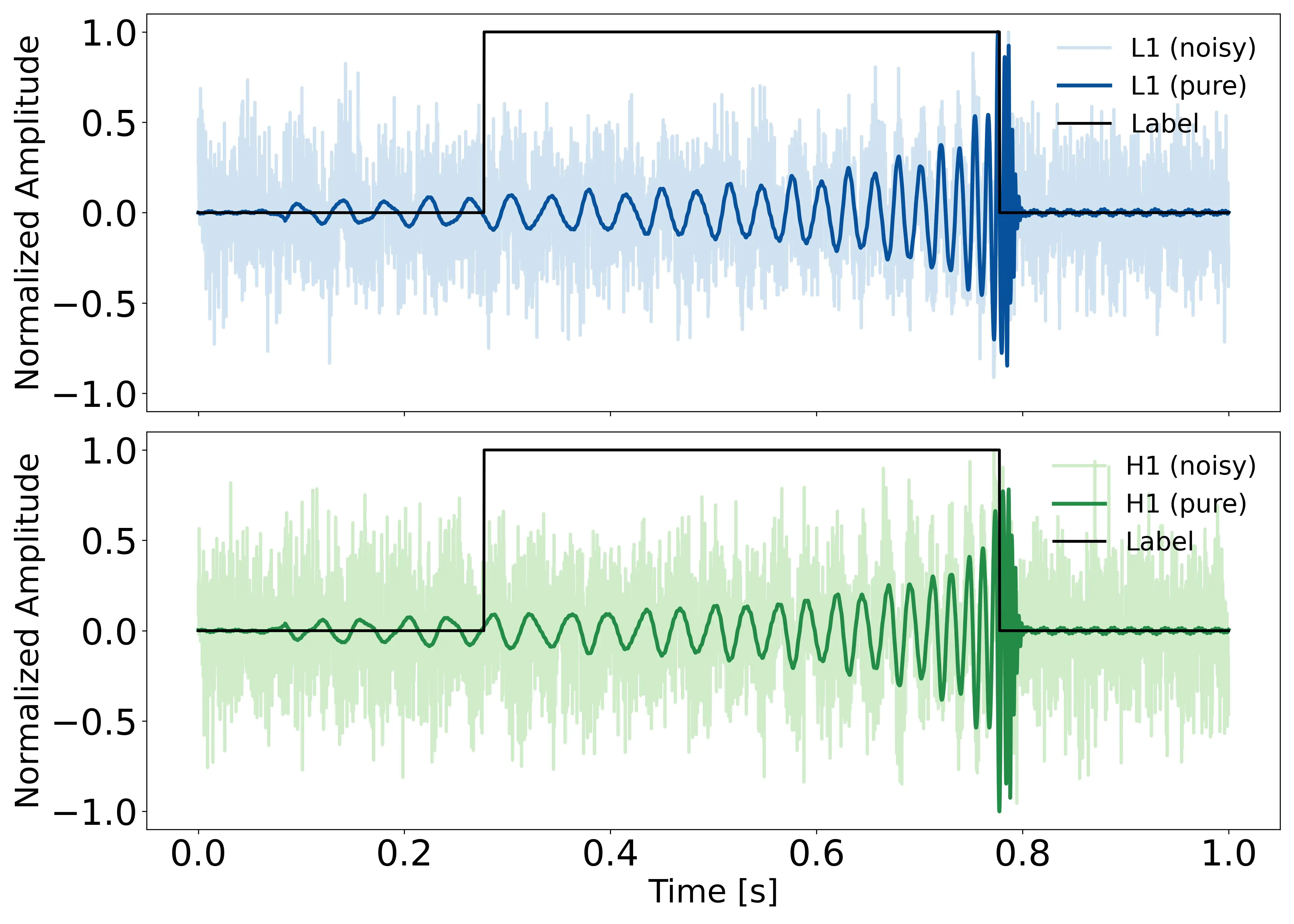
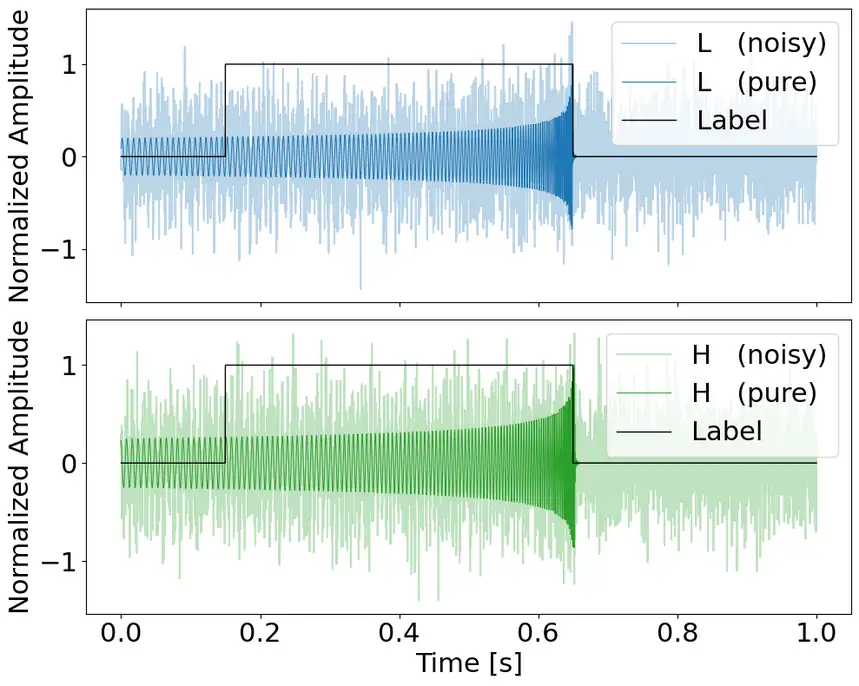
Figure 1–2. Whitened BBH (left) and BNS (right) injections in real LIGO noise for Hanford and Livingston. Both use labels set to 1 only in the 0.5 s preceding merger and 0 elsewhere; separate models are trained for each source class.
Models are trained on synthetic waveforms injected into real LIGO noise from the Gravitational Wave Open Science Center (GWOSC), using a curriculum that starts from louder injections and decays toward realistic signal-to-noise ratios. The data pre-processing pipeline involves glitch interpolation, whitening, band-passing, windowing, and label construction (with positive labels restricted to the pre-merger segment). The model returns a per-timestep score, while post-processing applies a calibrated, multi-criterion peak-finding stage (height, width, and plateau tests) to convert scores into reliable trigger times for use in downstream analyses.
In later experiments, I improved the training and inference pipeline around this same model. Among other changes, whitening is then performed using a longer context before the model input is cropped, the Hanford and Livingston channels use shared normalization, less agressive glitch rejection exposes the network to a more representative range of real detector noise, and trigger extraction is simplified to a smoothed maximum of the model output. These and other changes improved the performance of the cross-attention model and became part of the larger ablation study that grew out of the original AttenGW work.
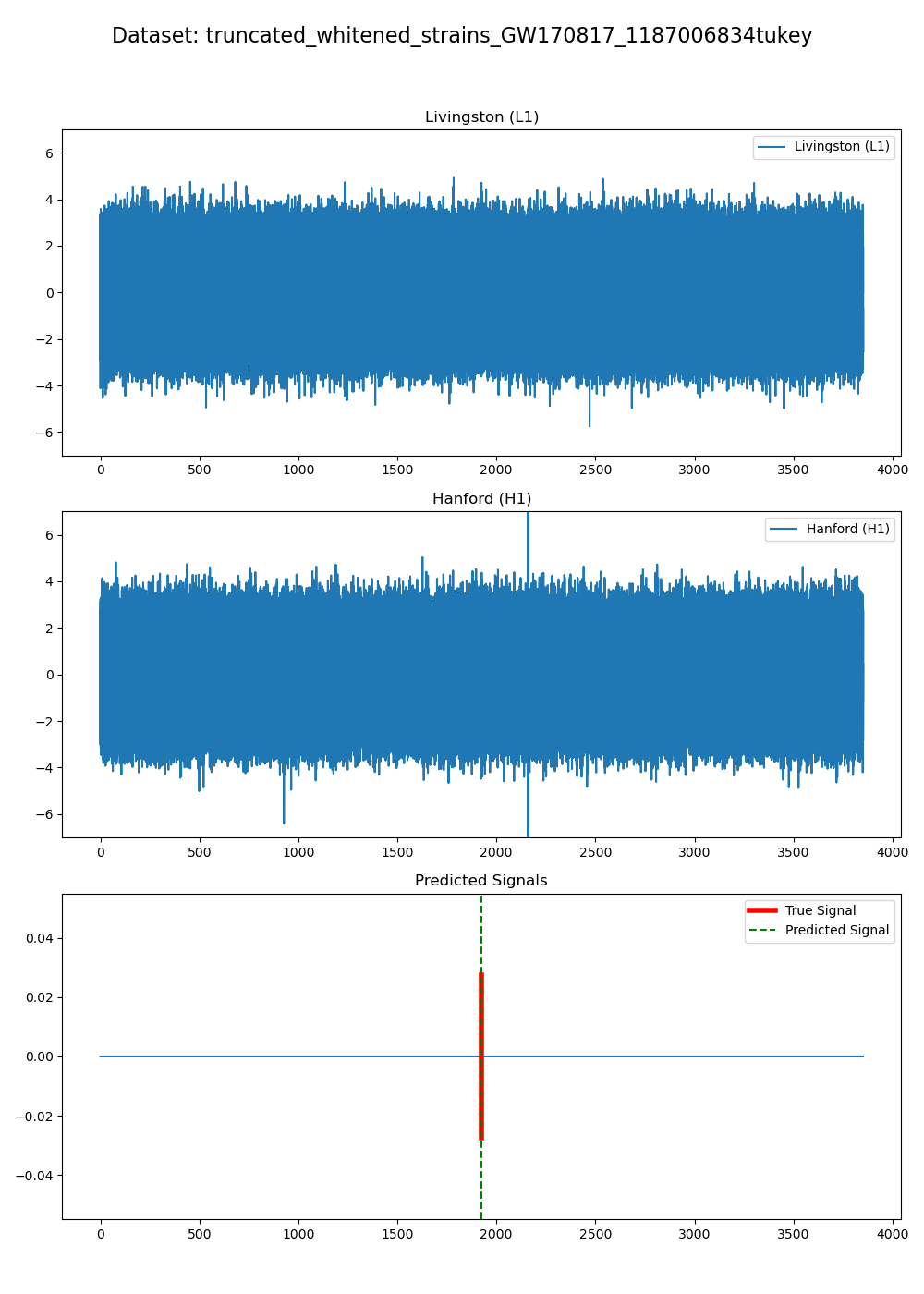
Figure 3. Example application to the binary neutron star event GW170817. Top: whitened L1 strain. Middle: whitened H1 strain. Bottom: model output and resulting trigger, correctly localizing the merger time in hour-long real interferometer data. A Tukey window is applied to a known glitch in the Livingston detector; the detection is robust to this choice.
Model Schematics:
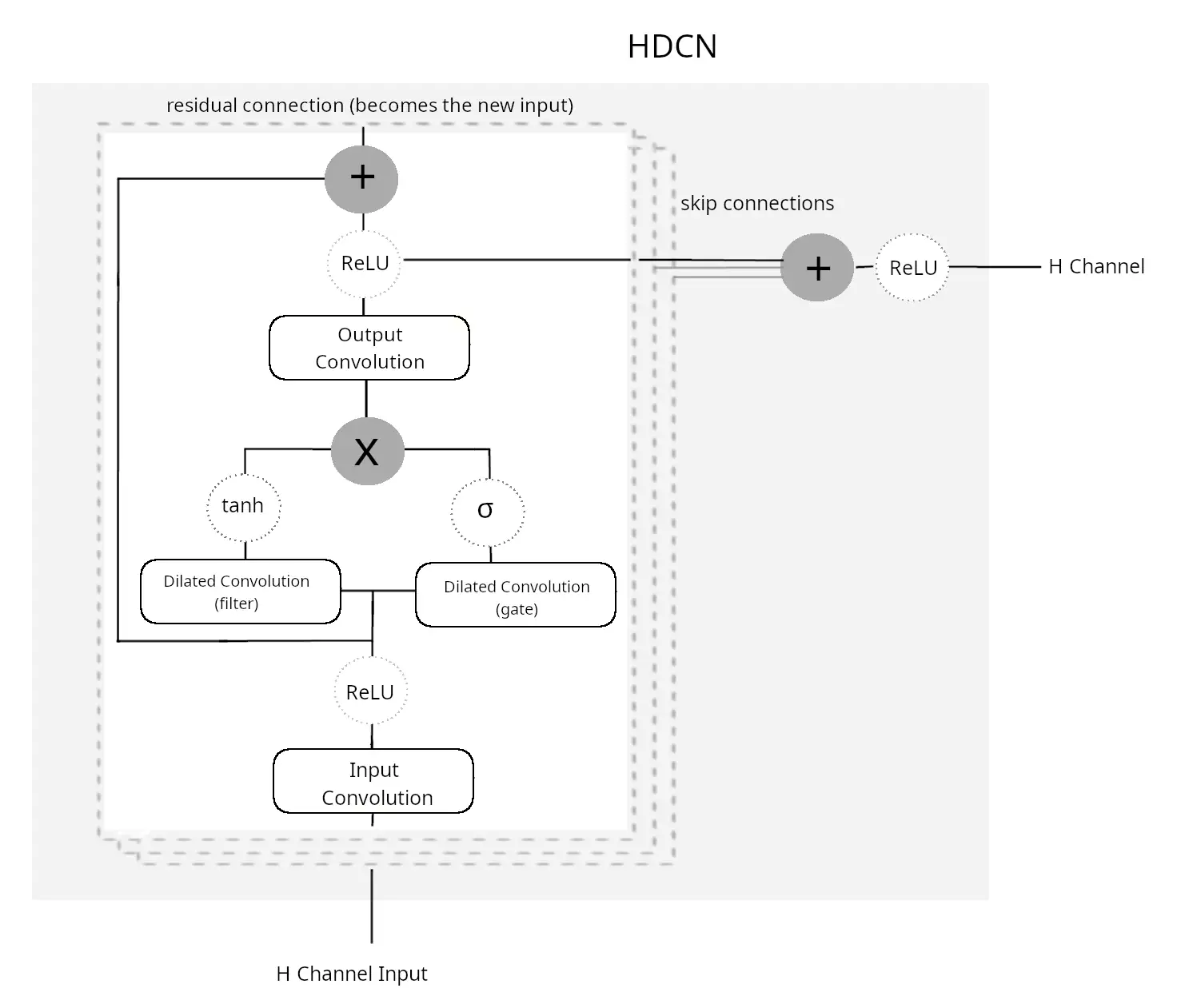
Figure 4. Hierarchical Dilated Convolutional Network (HDCN) used per detector to capture multi-scale temporal structure in the strain.
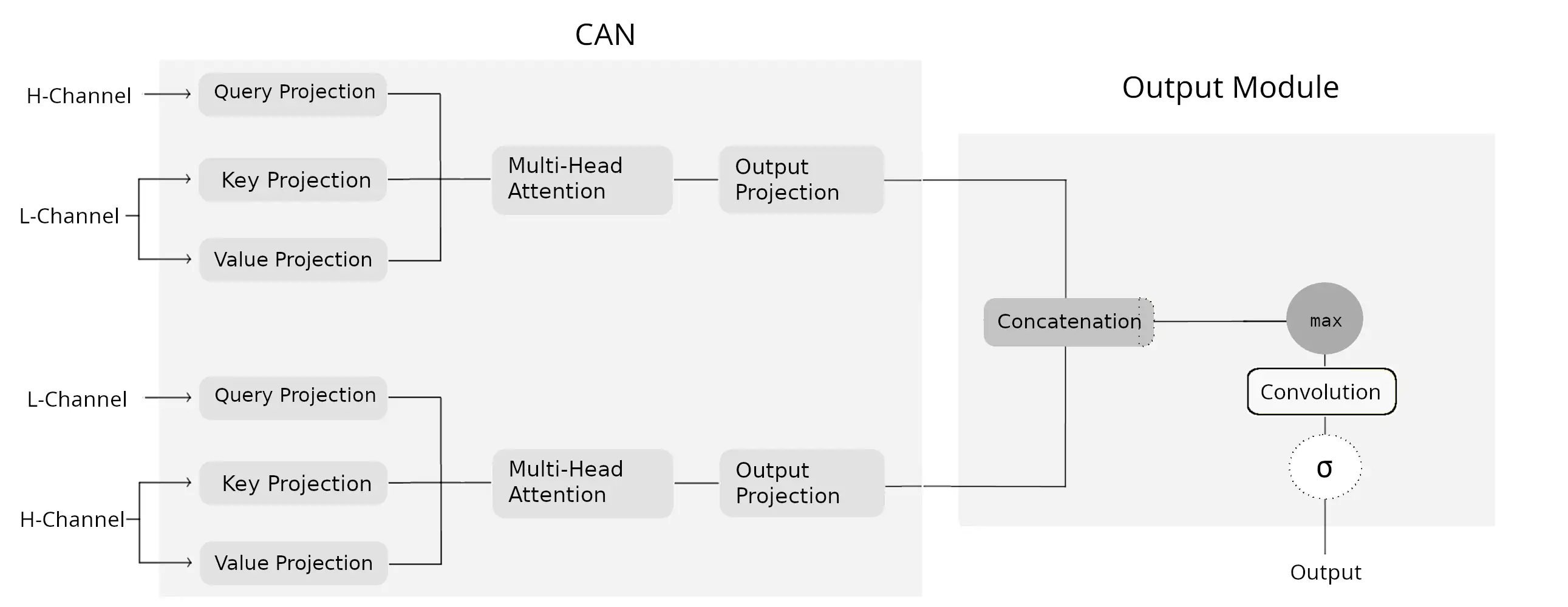
Figure 5. On the left, Cross-Attention Network (CAN) submodules that exchange information between detectors via multi-head attention, enabling detector-specific correlations to be modeled explicitly. On the right, final output module that aggregates enriched detector features into a per-timestep GW detection score suitable for low-latency triggering.
Benchmarks:
AttenGW is benchmarked on real O3 data and on injection studies in real LIGO noise. For comparability with prior work, the paper mirrors the February 2020 O3b segment previously used to evaluate a spatiotemporal graph ensemble. On this month of data, a single AttenGW model reduces false positives relative to a single graph-based detector by a factor of a few, and a 3-model AttenGW coincidence matches the background suppression previously reached with a 6-model ensemble (at matched detection efficiency). Injection studies on real noise further support the stability of attention-based aggregation on non-Gaussian backgrounds.
Once I improved the surrounding training and inference pipeline, the cross-attention model itself also performed better. The wider study that followed compared it with several other lightweight architectures and ultimately found that temporal convolutional networks outperformed the HDCN-based models, so most of the strongest final benchmarks in the expanded paper use those models instead. The original AttenGW architecture is still evaluated directly in the paper, including multi-seed injection studies of its sensitivity and run-to-run stability, but it no longer represents the work's strongest benchmark.
Federated Integration:RADAR is an example of how this kind of detector can be deployed in a federated setting: only compact trigger information and learned representations are shared with a coordinator, preserving data locality while enabling joint GW–EM analysis. I contributed by providing the GW detection module and helping shape the interfaces/requirements so it integrated cleanly, while the federated optimization, event fabric, and radio afterglow modeling were led by the broader RADAR team.
Related Work:This detector builds on and extends previous ML-based GW detection approaches, in particular by Tian et al. (2023) , and uses real strain data and catalogued events from the Gravitational Wave Open Science Center (GWOSC) . Our contribution retrains on injections into real GWOSC noise, modifies several parts of the original training and preprocessing workflow (including injecting signals into raw detector strain and whitening the combined strain rather than adding separately whitened signals to already whitened noise) redesigns the multi-detector aggregator with cross-attention for improved false-positive control, and provides a production-ready implementation suitable for integration into federated multi-messenger infrastructures. Further work on improving this workflow eventually grew into a broader study of preprocessing, training, inference, and alternative lightweight architectures, described in more detail on the gravitational-wave detection project page .